8,000 m Peaks by Difficulty: Gasherbrum II, Cho Oyu and Manaslu Compared

By Riaz Ahmed Shigri, Logistics and Marketing Manager, Chogori Adventure, Skardu · Updated November 2026
Which 8,000 m peak is the least demanding?
Cho Oyu (8,188 m) is usually called the least demanding 8,000 m peak: its normal route is the least technical, and it has the lowest death rate of the popular 8,000 m peaks. Manaslu (8,163 m) is the next common choice, but it is the most crowded 8,000 m peak in autumn. In Pakistan, Gasherbrum II (8,035 m) is often called the most accessible 8,000 m peak and the main summer option. Broad Peak is often called easy too, but its record says otherwise.
And no 8,000 m peak is easy. Every one of them has thin air, cold, objective dangers and a long summit day. The right first eight-thousander depends on the season you can travel, the skills you have and how you feel about crowds. This guide compares the four peaks climbers most often consider, then ranks all 14 eight-thousanders by difficulty, names the smallest and the deadliest, and explains how to choose your first one. If you searched for the least difficult 8,000 m peak, the short list is Cho Oyu, Manaslu and Gasherbrum II.
The four peaks at a glance
| Cho Oyu | Manaslu | Gasherbrum II | Broad Peak | |
|---|---|---|---|---|
| Height | 8,188 m | 8,163 m | 8,035 m | 8,051 m |
| Country and route | Tibet (China), north-west ridge | Nepal, north-east face | Pakistan, south-west ridge | Pakistan, west spur |
| Getting to base camp | Mostly by road | Road, then about a week on foot | About 8 days on foot up the Baltoro Glacier | The same Baltoro approach |
| High camps | 3 | 4 | 3, sometimes 4 | 3 |
| Hardest part | A short ice cliff at about 6,600 m and the Yellow Band | The broken glacier between Camps 1 and 2; the narrow true-summit ridge | The icefall below Camp 1, the Banana Ridge and the traverse below the summit | The gully to the col and a very long summit ridge |
| Season | Autumn (spring possible) | Autumn and spring | Summer | Summer |
| Crowds | Few teams in recent seasons | Hundreds of climbers in autumn | Tens of climbers | Tens of climbers |
| Deaths per summit, 1950–2012 | About 1.4% | About 9.8% (likely lower since) | About 2.3% | About 5.2% |
Death rates are deaths divided by summits, from the sources in the death-rate section below, each with its own date. They give an idea of risk, not a promise for any one season.
What makes an 8,000 m peak “easy”?
Six things decide how demanding an 8,000 m peak is: the technical grade of the route, the objective hazards, the death record, the access, the season and the crowds. Height matters less than most people think: the difference between 8,027 m and 8,188 m is small next to the difference between a snow ridge and an avalanche-prone face.
- Technical difficulty: how steep the route is and how much ice or rock climbing it has.
- Objective hazards: avalanches, icefalls, seracs and rockfall that skill alone cannot remove.
- The death rate: how many climbers have died for every summit.
- Access: whether you drive to base camp or walk for a week, and how far help is.
- Season and weather: when the peak can be climbed and how reliable the summit window is.
- Crowds: queues on fixed ropes slow everyone down, but other teams also share the work of fixing the route.
Two more factors are easy to miss. The first is the length of summit day: on most 8,000 m peaks you leave the top camp around midnight and climb 700 to 1,100 m of height, so the day lasts 10 to 18 hours up and down. A route with a high top camp and a short summit push is far less tiring than one with a long ridge at 8,000 m. The second is how the mountain is usually climbed today. A peak with fixed ropes from base camp to the summit, many teams and a well-known route is a different climb from the same peak in a quiet year, when your own team must break trail and fix every rope.
All 14 8,000 m peaks ranked by difficulty
By their normal routes, the 14 eight-thousanders range from Cho Oyu, Manaslu and Gasherbrum II at the least demanding end to Annapurna, Kangchenjunga and K2 at the hardest. The ranking below weighs the technical grade, the objective hazards, the length of summit day and the historical death rate. It is our reading of these factors, not an official scale, and the order inside each group is open to debate.
| Rank | Peak | Height | Country | Normal route and main difficulty | Deaths per summit, 1950–2012 |
|---|---|---|---|---|---|
| 1 | Cho Oyu | 8,188 m | China (Tibet), Nepal | North-west ridge; short ice step and the Yellow Band | About 1.4% |
| 2 | Manaslu | 8,163 m | Nepal | North-east face; seracs between Camps 1 and 2 | About 9.8% (likely lower since) |
| 3 | Gasherbrum II | 8,035 m | Pakistan, China | South-west ridge; icefall and avalanche-prone slopes | About 2.3% |
| 4 | Shishapangma | 8,027 m | China (Tibet) | North side; avalanche slopes and an exposed ridge to the main summit | About 8.3% |
| 5 | Everest | 8,849 m | Nepal, China | South Col or North Ridge; extreme altitude, the Khumbu Icefall, crowds | About 3.9% |
| 6 | Lhotse | 8,516 m | Nepal, China | West face; the Lhotse Face and a narrow, rocky summit couloir | About 2.8% |
| 7 | Broad Peak | 8,051 m | Pakistan, China | West spur; rockfall and a very long summit ridge | About 5.2% |
| 8 | Makalu | 8,485 m | Nepal, China | North-west ridge; steep rock and ice on the summit pyramid | About 8.6% |
| 9 | Gasherbrum I | 8,080 m | Pakistan, China | Japanese Couloir; slopes of 50–55° below the summit | About 8.7% |
| 10 | Dhaulagiri I | 8,167 m | Nepal | North-east ridge; avalanches, wind and route finding | About 15.4% |
| 11 | Nanga Parbat | 8,126 m | Pakistan | Kinshofer route; a steep rock and ice wall, rockfall | About 20.3% |
| 12 | Kangchenjunga | 8,586 m | Nepal, India | South-west face; remoteness and a very long summit day | About 16% |
| 13 | Annapurna I | 8,091 m | Nepal | North face; avalanches and falling seracs | About 31.9% |
| 14 | K2 | 8,611 m | Pakistan, China | Abruzzi Spur; the Bottleneck below a large serac | About 23% (to 2016) |
Death rates in this table are deaths divided by summits from 1950 to March 2012, from the counts compiled by the German 8,000 m statistician Eberhard Jurgalski; the K2 figure is Alan Arnette’s count to 2016. Manaslu’s figure stands out: it comes from years when few teams climbed it, and summit numbers have grown sharply since, so its rate per summit today is likely much lower. Use the column to compare the mountains, not to predict a season.
Group 1: the most accessible (Cho Oyu, Manaslu, Gasherbrum II)
These three are the usual first eight-thousanders. Their normal routes are mostly snow and ice of moderate angle, with short steeper sections on fixed ropes, and their summit days are shorter than on most other peaks. Cho Oyu has the lowest death rate of any 8,000 m peak in the counts cited here. Manaslu is the most climbed in autumn. Gasherbrum II is the only one of the three in the Karakoram and the only one climbed in summer. We describe each one in its own section below.
Group 2: moderate routes with one big problem (Shishapangma, Everest, Lhotse, Broad Peak)
Each of these has a normal route that is not very technical, but each has one feature that raises the stakes. Shishapangma (8,027 m) is the smallest 8,000 m peak, but the main summit lies at the end of an exposed ridge beyond the central summit, and the slopes below it are avalanche-prone. Everest (8,849 m) is not technical by its normal routes and has the most support of any mountain, but it is 660 m higher than Cho Oyu, its summit day from the South Col climbs about 950 m in the death zone, and the Khumbu Icefall on the Nepal side is a serious objective hazard. Lhotse (8,516 m) shares Everest’s route up to the Lhotse Face, then finishes in a narrow, rocky couloir with loose stones. Broad Peak (8,051 m) has an easy reputation and a hard record, as we explain below.
Group 3: serious climbs (Makalu, Gasherbrum I, Dhaulagiri)
Makalu (8,485 m) is the fifth-highest mountain, with a pyramid-shaped summit that ends in steep rock and ice; its top section is harder than anything on Cho Oyu or Manaslu, and the camp at the Makalu La (about 7,400 m) is windy and cold. Gasherbrum I (8,080 m), the Hidden Peak, is the harder of the two Gasherbrums: the Japanese Couloir is steep and exposed, and the slopes below the summit reach 50–55°. Dhaulagiri I (8,167 m) has a long, avalanche-prone route where finding the way in poor visibility is a real problem, and strong winds often close its summit window.
Group 4: the most demanding (Nanga Parbat, Kangchenjunga, Annapurna, K2)
These four have the highest death rates and the most serious normal routes. Nanga Parbat (8,126 m), the western end of the Himalaya in Pakistan, is climbed by the Kinshofer route on the Diamir face, which has a steep wall of rock and ice low down and rockfall in warm weather. Kangchenjunga (8,586 m), the third-highest mountain, is remote, with a summit day of 12 hours or more from a top camp at about 7,600 m. Annapurna I (8,091 m) has the worst historical record: about one death for every three summits to 2012, mostly from avalanches and falling seracs on the north face. K2 (8,611 m) is technical from base camp to the top, and summit day passes below a large serac in the Bottleneck at about 8,200 m. Read more in our K2 climbing guide.
Cho Oyu: usually called the least demanding
Cho Oyu (8,188 m), the sixth-highest mountain on Earth, stands on the border between Nepal and Tibet. It is normally climbed from Tibet, China, by the north-west ridge, with permits from the Chinese authorities. Base camp is reached mostly by road, and the route has three high camps. The main obstacles are a short ice cliff at about 6,600 m and the rock of the Yellow Band higher up; most of the rest is snow slopes of moderate angle. It has the lowest death rate of the four peaks here, about 1.4% from 1950 to 2012. The Tibet side has been closed to foreign climbers in some seasons, so check before you plan.
Cho Oyu was first climbed on 19 October 1954 by Herbert Tichy, Joseph Jöchler and Pasang Dawa Lama, a small team without bottled oxygen. Its summit is a wide plateau, and the true high point is a few hundred metres across it, where climbers first see Everest. On a clear day that view is the proof that you reached the top.
Manaslu: popular and crowded
Manaslu (8,163 m), the eighth-highest mountain, is in Nepal and is reached by road and then about a week on foot. It has four high camps, and the broken glacier between Camps 1 and 2 is the trickiest part, with ice walls and seracs. Manaslu is the busiest 8,000 m peak in autumn, with several hundred climbers in a season. Its true summit sits at the end of a narrow, exposed ridge where only one person can stand at a time; before 2021 most climbers stopped at a lower point and believed they had reached the top.
Manaslu was first climbed on 9 May 1956 by Toshio Imanishi and Gyalzen Norbu of a Japanese expedition. The slopes below Camp 3 are open to avalanches after heavy snow, so the timing of the climb matters as much as the route. Most teams use fixed ropes all the way and bottled oxygen above Camp 3.
Gasherbrum II: the summer choice in Pakistan
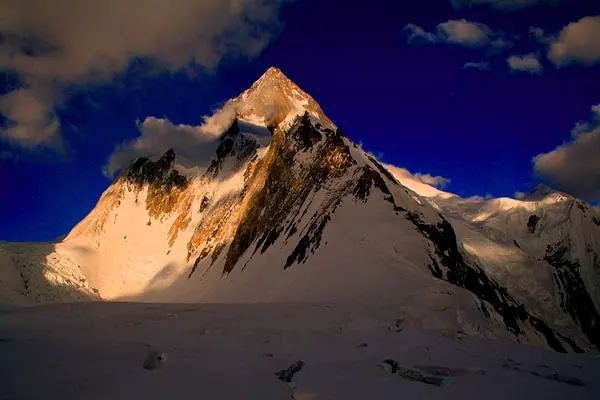
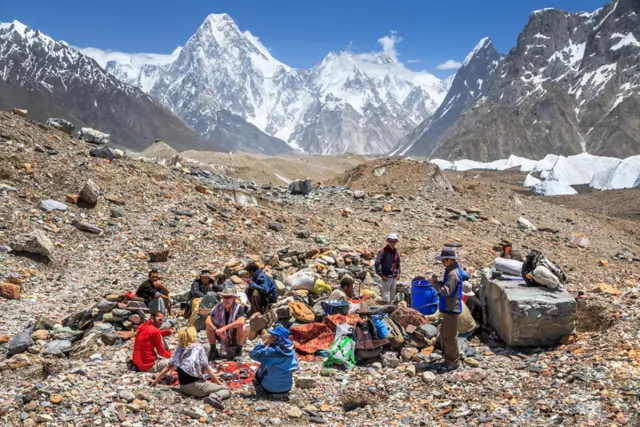
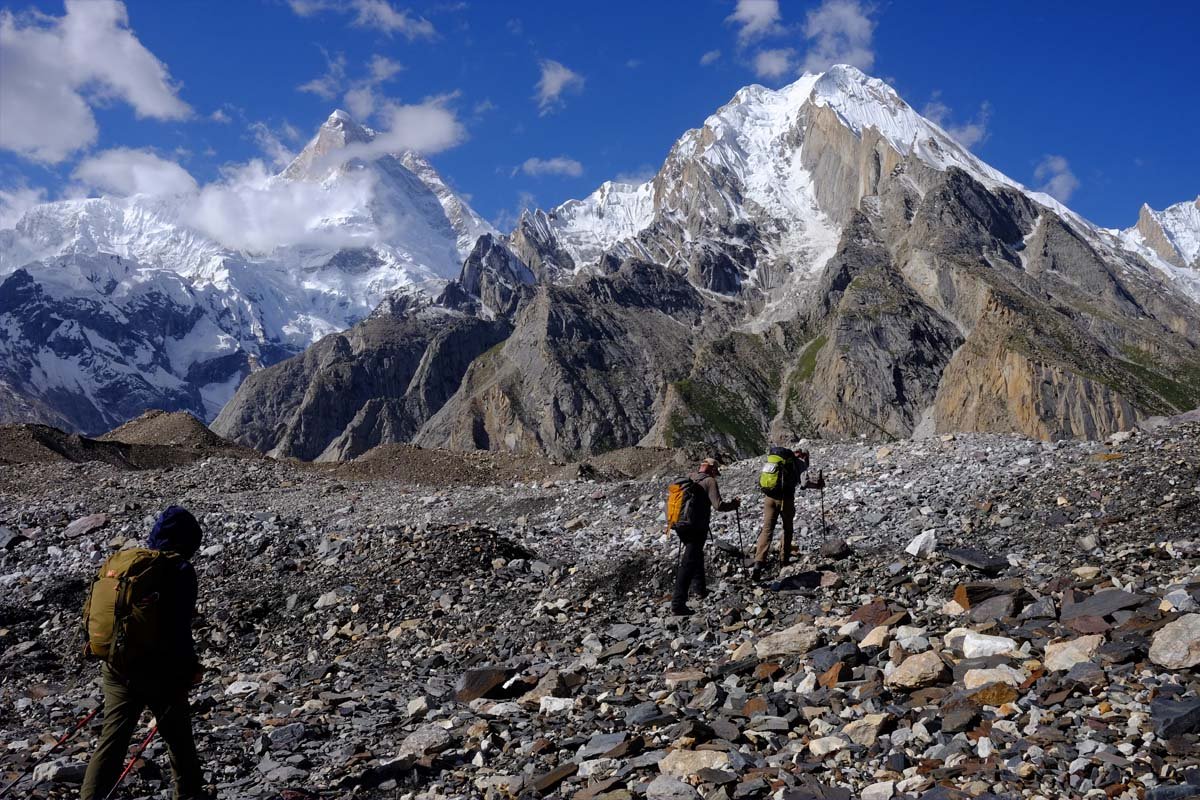
Gasherbrum II (8,035 m), the thirteenth-highest mountain, is often called the most accessible 8,000 m peak in Pakistan. It is climbed in summer, when the Himalaya in Nepal and Tibet are in the monsoon, so it is the natural choice if your holidays fall in June, July or August. The approach is a real expedition in itself: about 8 days on foot up the Baltoro Glacier, past Concordia, with views of K2 and Broad Peak.
On the mountain, the route crosses the Gasherbrum icefall to Camp 1 (about 6,000 m), climbs the curving Banana Ridge to Camp 2 (about 6,400 m), crosses avalanche-prone slopes above it, and continues on the south-west ridge to Camp 3 (about 7,000 m) and sometimes Camp 4 (about 7,400 m). Summit day is about 7 hours from Camp 4, with a traverse below the summit pyramid and a narrow final ridge. Its death rate, about 2.3% from 1950 to 2012, is among the lowest of the 14 eight-thousanders, and you will share the mountain with tens of climbers, not hundreds.
Gasherbrum II was first climbed on 7 July 1956 by the Austrians Fritz Moravec, Josef Larch and Hans Willenpart, by the south-west ridge. On 2 February 2011 it became the first 8,000 m peak in Pakistan to be climbed in winter. Gasherbrum Base Camp is at about 5,100 m on the Abruzzi Glacier, a long day’s walk (about 6–8 hours) beyond Concordia, and Gasherbrum I shares the same base camp and Camp 1.
See our Gasherbrum II Expedition, or climb both Gasherbrums on our Gasherbrum I and II Expedition.
Is Broad Peak easy?
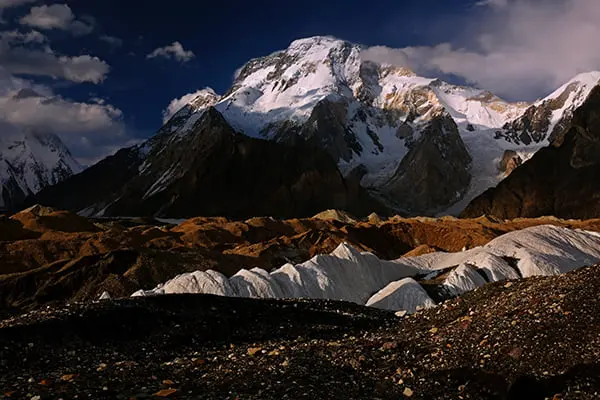
No. Broad Peak (8,051 m), next to K2, is often called one of the easier 8,000 m peaks because its normal route is not very technical. But its record is worse than that of the other three: a death rate of about 5.2% from 1950 to 2012. The route has rockfall low down, an avalanche-prone slope below the col and a very long summit day along a ridge. The ridge first reaches a fore-summit, and the main summit is still an hour or more further on; many climbers have stopped at the fore-summit by mistake.
Broad Peak Base Camp is at about 4,850 m on the Godwin-Austen Glacier, lower than the Gasherbrum and K2 base camps, and the three high camps are at about 5,700 m, 6,300 m and 7,000 m. From Camp 3 the summit is about 1,050 m higher, via the col at about 7,700 m and the Rocky Summit (about 8,030 m), so summit day is one of the longest on any of the first-choice peaks. The peak was first climbed on 9 June 1957 by Hermann Buhl, Kurt Diemberger, Marcus Schmuck and Fritz Wintersteller, without bottled oxygen or high-altitude porters.
Broad Peak is a fine objective for an experienced climber, but it is not the least demanding first 8,000er. See our Broad Peak Expedition.
Which 8,000 m peak is the smallest?
Shishapangma, at 8,027 m, is the smallest of the 14 eight-thousanders; Gasherbrum II (8,035 m) is the second smallest and the smallest in Pakistan. Shishapangma stands entirely in Tibet, China, and was the last 8,000 m peak to be climbed, on 2 May 1964, by a Chinese team led by Xu Jing.
Smallest does not mean least demanding. Shishapangma has two summits: a central summit at about 8,008 m and the main summit a little higher, reached along an exposed, often corniced ridge. Careful research by 8,000 m statisticians has shown that many climbers who reported a summit in the past stopped at the central summit. The slopes below the ridge are also open to avalanches. Like Cho Oyu, it depends on permits from the Chinese authorities. Gasherbrum II, by contrast, has a clearer summit and a shorter final section, which is one reason it is chosen more often as a first 8,000 m peak.
Which 8,000 m peak is the deadliest?
Annapurna I (8,091 m) has the highest historical death rate: about 32 deaths for every 100 summits from 1950 to March 2012. K2 (about 23% to 2016) and Nanga Parbat (about 20% to 2012) come next. Annapurna was also the first 8,000 m peak climbed, by Maurice Herzog and Louis Lachenal on 3 June 1950.
The reasons differ. On Annapurna, most deaths come from avalanches and falling ice on the north face, a hazard that skill cannot remove. On K2, the route is steep from bottom to top, the weather changes fast, and the Bottleneck puts climbers under a serac at about 8,200 m. On Nanga Parbat, the long Diamir face has rockfall and avalanches. Rates on K2 and some other peaks have come down as more climbers summit with fixed ropes and bottled oxygen, but these mountains remain in a different class from Cho Oyu or Gasherbrum II.
Death rates compared
| Peak | Deaths per summit | Data |
|---|---|---|
| Cho Oyu | About 1.4% | 3,138 summits and 44 deaths (1950 to March 2012); Himalayan Database climber death rate 0.64% (1950–2009) |
| Manaslu | About 9.8% | 661 summits and 65 deaths (1950 to March 2012); Himalayan Database climber death rate 2.77% (1950–2009) |
| Gasherbrum II | About 2.3% | 930 summits and 21 deaths (data to 2012) |
| Broad Peak | About 5.2% | 404 summits and 21 deaths (data to 2012) |
These numbers change every season, and they are not collected the same way for every mountain. Manaslu’s summit numbers, for example, have grown many times over since 2012, so its rate per summit today is likely much lower than the 2012 figure. Use them as a rough guide, together with the route and the season.
Two more points help when you read them. First, a rate per summit is not your chance of dying on one attempt: many more people try a peak than reach the top, so the risk per attempt is lower, but a death rate per summit is the only figure collected the same way for every mountain. Second, the counts include Nepali and Pakistani high-altitude staff, who often spend more days on the route than their clients. The Himalayan Database, started by the journalist Elizabeth Hawley in Kathmandu, gives a separate, lower “climber death rate” for Nepal’s peaks, worked out per member above base camp: about 0.64% for Cho Oyu from 1950 to 2009, against 1.52% for Everest.
The five 8,000 m peaks of Pakistan
Pakistan has five of the 14 eight-thousanders: K2 (8,611 m), Nanga Parbat (8,126 m), Gasherbrum I (8,080 m), Broad Peak (8,051 m) and Gasherbrum II (8,035 m). Four of them stand within about 20 km of Concordia (4,691 m) at the head of the Baltoro Glacier; Nanga Parbat stands alone at the western end of the Himalaya, about 180 km away.
| Peak | Height | World rank | First ascent | First winter ascent | Difficulty group |
|---|---|---|---|---|---|
| K2 | 8,611 m | 2 | 31 July 1954 (Italian expedition: Achille Compagnoni and Lino Lacedelli) | 16 January 2021 (a Nepali team of ten) | 4, most demanding |
| Nanga Parbat | 8,126 m | 9 | 3 July 1953 (Hermann Buhl, alone, from the last camp) | 26 February 2016 | 4, most demanding |
| Gasherbrum I | 8,080 m | 11 | 5 July 1958 (Pete Schoening and Andy Kauffman) | 9 March 2012 | 3, serious |
| Broad Peak | 8,051 m | 12 | 9 June 1957 (Austrian team of four) | 5 March 2013 | 2, one big problem |
| Gasherbrum II | 8,035 m | 13 | 7 July 1956 (Austrian team of three) | 2 February 2011 | 1, most accessible |
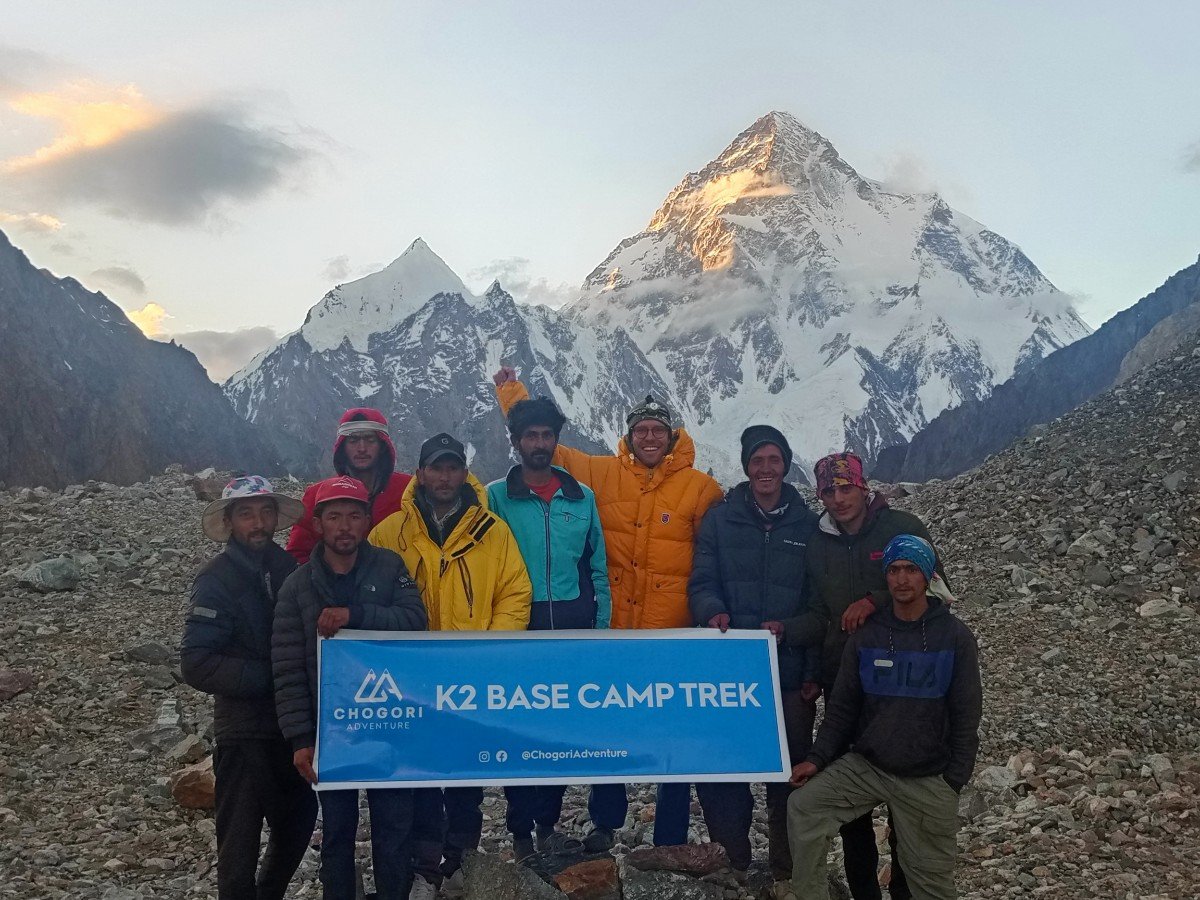
The four Baltoro peaks share one approach. From Skardu (2,230 m) a jeep road runs to Askoli (Askole), the last village, and from there the trek follows the Braldu river to Paiju and then the Baltoro Glacier, about 63 km long, past Khoburtse, Urdukas and Goro II to Concordia. Broad Peak Base Camp (about 4,850 m) and K2 Base Camp (about 5,150 m) lie up the Godwin-Austen Glacier to the north; Gasherbrum Base Camp (about 5,100 m) lies up the Abruzzi Glacier to the east. This shared approach is why a strong team can attempt two of these peaks in one summer, and why the walk in is part of the acclimatisation. If you only want to see these mountains, our K2 Base Camp Trek follows the same route to Concordia and K2 Base Camp. Our Baltoro Glacier trekking tips describe the glacier stage by stage.
In order of difficulty, Gasherbrum II comes first, then Broad Peak, then Gasherbrum I, with K2 and Nanga Parbat at the top of the scale. We run expeditions to four of the five: Gasherbrum II, Broad Peak, Gasherbrum I and the K2 Climbing Expedition. For Nanga Parbat we run treks, not climbs: our Nanga Parbat Base Camp Trek goes from Fairy Meadows to the foot of its north face.
Choosing by season
Your travel dates often decide your first 8,000 m peak: Nepal and Tibet in spring or autumn, Pakistan in summer. The monsoon reaches the Himalaya of Nepal and Tibet from June to September but has much less effect on the Karakoram, which lies further north and west.
- Spring (April–May) and autumn (September–October): the seasons for Nepal and Tibet, including Manaslu and Cho Oyu.
- Summer (late June to early August): the season for the Karakoram in Pakistan, including Gasherbrum II and Broad Peak. Our fixed departures start on 20 June.
In the Karakoram, a typical season runs like this. Teams fly to Skardu in the second half of June and walk in during the last days of June. The first rotations to Camps 1 and 2 happen in early July, while the rope-fixing teams work higher. Most summit windows on Gasherbrum II and Broad Peak come between about 10 July and the end of July, and Gasherbrum I and K2 often go a little later. By mid-August the weather usually turns, and the porters walk out the last teams. The best time to climb our 8,000 m peaks is from 20 June to 8 August.
How to choose your first 8,000 m peak
Choose your first 8,000 m peak by season first, then by the route’s technical grade, then by crowds and support. For most climbers this gives Cho Oyu or Manaslu in autumn, or Gasherbrum II in summer. Ask yourself these questions.
1. When can you travel?
An 8,000 m expedition takes six to eight weeks. Our single-peak expeditions in Pakistan take 50 days from Islamabad back to Islamabad, and the Gasherbrum I and II combination takes 60. If you can only get time off in June, July or August, Gasherbrum II is the natural first choice; if your free weeks fall in April–May or September–October, look at the Himalayan peaks.
2. How much technical climbing can you do at altitude?
All the first-choice peaks need crampon and ice-axe skills, fixed-rope technique with a jumar (ascender) and abseiling on a figure-eight or similar device, all in thick gloves. Gasherbrum II and Manaslu have more steep ice and broken glacier than Cho Oyu. If you climb steep ice confidently, the difference is small; if you are still learning, it matters.
3. Do you want crowds or quiet?
A busy peak has well-trodden tracks, fixed ropes and other teams nearby, but also queues and pressure to keep moving. A quieter peak gives you more space and more responsibility. Gasherbrum II sees tens of climbers in a season, Manaslu several hundred.
4. How remote is the mountain?
Cho Oyu has road access close to base camp. Manaslu and the Karakoram peaks need a long walk, and the Baltoro is about a week from the road end at Askoli. Remoteness adds acclimatisation and scenery, but also distance from roads if you fall ill. Make sure your insurance covers helicopter rescue.
5. What support will you have?
Decide whether you want only base camp services and will climb with your own team, or full support above base camp. In Pakistan, our two packages cover both cases; see the prices below.
The experience ladder: from 6,000 m to 8,000 m
We recommend at least one 7,000 m peak before your first 8,000 m peak. It is not a strict rule, and we will look at your experience case by case, but a 7,000 m climb tells you how your body, your boots and your gloves cope with long days above 6,500 m.
A common path in Pakistan has three steps. First, a 6,000 m peak with glacier travel and fixed ropes, such as our 12-day Khosar Gang Expedition. Once you have climbed above 6,000 m, a more technical 6,000 m peak such as our Pastore Peak Climbing Expedition above the Baltoro is a good next test. Second, a 7,000 m peak: our 28-day Spantik Expedition climbs Spantik (7,027 m) by the south-east ridge, with camps at about 5,100 m, 5,600 m and 6,250 m and a summit day of 10 to 15 hours. Third, an 8,000 m peak such as Gasherbrum II. Each step teaches something the next one needs: rope work, cold management, and the patience to wait for a weather window. For more 6,000 m ideas, see our guide to the top five trekking peaks in Pakistan.
Before your first 8,000 m peak
- We recommend climbing at least one 7,000 m peak first.
- Be at home on fixed ropes with a jumar and crampons, in thick gloves, at high altitude.
- Train for months, and test your boots, down suit and gloves on a 7,000 m peak.
- Plan for oxygen: most climbers use bottled oxygen high on the mountain.
- Get mountaineering insurance that covers helicopter rescue and evacuation.
- Pack the right gear: see our packing list (PDF).
Training should start at least six months before departure. The core is long days on your feet with a pack of 15 to 20 kg and plenty of height gain, built up week by week, plus strength work for the legs and core. Climbers who live far from mountains often use stairs or a steep treadmill. Before you travel, read our notes Before you trek in Pakistan on visas, travel and health.
Mistakes first-time 8,000 m climbers make
Most problems on a first 8,000 m peak come from choices made before the summit push, not from the hardest pitch. These are common mistakes.
- Choosing by height or reputation alone. Broad Peak is often called easy; its record says it is not. Look at the route and the hazards.
- Skipping the 7,000 m step. The first long day above 7,000 m should not be on summit day of an 8,000 m peak.
- Rushing acclimatisation. Rotations to Camps 1, 2 and 3 take time. A plan that is too tight leaves no room for bad weather.
- Ignoring the turnaround time. Summit day must have a fixed time to turn back. On Broad Peak, Manaslu and Shishapangma, the true summit is beyond a fore-summit, so plan for it.
- Untested gear. New boots, a new down suit or new gloves should never be used for the first time above base camp.
- Too little oxygen. If you plan to use bottled oxygen, know how many bottles you have, at what flow rate, and where they are stored.
Climbing Gasherbrum II with us
Our Gasherbrum II Expedition takes 50 days from Islamabad, starting on 20 June. Base Camp Only costs $10,000 per person and Full Board $25,000, with the royalty, permits and liaison officer included. Full Board adds one Pakistani high-altitude porter for every two climbers, a local rope-fixing team with ropes and fixing gear, high-camp tents, gas and stoves, oxygen (2 bottles per climber and 2 for each high-altitude porter) and meals above base camp. For every cost, read our K2 cost guide; the extras are the same.
Our other 8,000 m expeditions use the same two packages. The Gasherbrum I Expedition and the Broad Peak Expedition cost $10,000 (Base Camp Only) or $25,000 (Full Board) for 50 days. The Gasherbrum I and II Expedition, climbing Gasherbrum II first, costs $12,000 or $26,000 for 60 days, with both royalties included. The K2 Climbing Expedition costs $12,000 or $26,000 for 50 days. Groups are 3 to 10 climbers, and private expeditions can be arranged at any time of year. We do not sell a summit: the weather, the snow and your own condition decide the outcome, and the decision to turn around is made on the mountain.
Frequently asked questions
What is the least demanding 8,000 m peak?
Cho Oyu (8,188 m) is usually called the least demanding 8,000 m peak. Its north-west ridge from Tibet is the least technical normal route, base camp is reached mostly by road, and it has the lowest death rate of any 8,000 m peak, about 1.4% deaths per summit from 1950 to 2012. Manaslu and, in summer, Gasherbrum II are the next choices. But no 8,000 m peak is easy.
What is the least demanding 8,000 m peak for beginners?
None is for real beginners. Every 8,000 m peak needs crampon, ice-axe and fixed-rope skills and experience of long days at high altitude. For a first 8,000er, climbers usually choose Cho Oyu or Manaslu in spring or autumn, or Gasherbrum II in summer. We recommend at least one 7,000 m peak, such as Spantik (7,027 m), before you try one.
Is Gasherbrum II easy?
No, though it is often called the most accessible 8,000 m peak in Pakistan. The route is mostly snow and ice, with camps at about 6,000 m, 6,400 m and 7,000 m. But the icefall below Camp 1, the avalanche-prone slopes above Camp 2 and a summit day of about 7 hours from Camp 4 need experience, fitness and good judgment.
Is Broad Peak easy to climb?
No. Its normal route is not very technical, but it has rockfall low down, an avalanche-prone slope below the col and a very long summit ridge, with a fore-summit about an hour before the main summit. Its death rate, about 5.2% per summit to 2012, is higher than on Cho Oyu, Manaslu or Gasherbrum II.
Is Manaslu harder than Cho Oyu?
Yes, by most accounts. Manaslu has four high camps instead of three, a broken glacier with seracs between Camps 1 and 2, avalanche-prone slopes after heavy snow and a narrow true summit where one person stands at a time. Cho Oyu’s route is mostly moderate snow with one short ice step and the rock of the Yellow Band.
Which 8,000 m peak has the lowest death rate?
Cho Oyu, in the counts cited here: about 1.4% deaths per summit (3,138 summits and 44 deaths, 1950 to March 2012), and a Himalayan Database climber death rate of 0.64% (1950–2009). In Pakistan, Gasherbrum II has the lowest rate, about 2.3% (930 summits and 21 deaths to 2012). Rates change every season and are a rough guide only.
Which 8,000 m peak can I climb in summer?
The Karakoram peaks in Pakistan: Gasherbrum II, Broad Peak, Gasherbrum I and K2, and Nanga Parbat at the western end of the Himalaya. The season runs from late June to early August, while the monsoon covers Nepal and Tibet. Our fixed departures start on 20 June, and the best time to climb is from 20 June to 8 August.
Do I need oxygen on my first 8,000 m peak?
Most climbers use bottled oxygen high on the mountain, usually from the top camp or the camp below it, and we recommend it on a first 8,000 m peak. It keeps you warmer and helps your judgment on summit day. Our Full Board packages include oxygen: 2 bottles per climber and 2 for each high-altitude porter.
What experience do I need before an 8,000 m peak?
We recommend at least one 7,000 m peak first, such as Spantik (7,027 m). It is not a strict rule, so tell us about your experience and we will advise you. You must also be at home on fixed ropes with a jumar and crampons in thick gloves, and have spent long days above 6,000 m.
How much does Gasherbrum II cost with Chogori Adventure?
Our Gasherbrum II Expedition costs $10,000 per person on Base Camp Only or $25,000 on Full Board, for 50 days from Islamabad back to Islamabad. The royalty, permits and liaison officer are included in both. Full Board adds high-altitude porters, a rope-fixing team, high-camp tents and oxygen. Private group prices depend on your group size.
What is the smallest 8,000 m peak?
Shishapangma, at 8,027 m, in Tibet, China, is the smallest of the 14 eight-thousanders, and it was the last to be climbed, in 1964. Gasherbrum II (8,035 m) is the second smallest and the smallest in Pakistan. Smallest does not mean least demanding: Shishapangma’s main summit lies along an exposed ridge beyond the central summit.
Which 8,000 m peak is the deadliest?
Annapurna I (8,091 m) has the highest historical death rate, about 32 deaths for every 100 summits from 1950 to 2012, mostly from avalanches and falling seracs. K2 (about 23% to 2016) and Nanga Parbat (about 20% to 2012) come next. Rates have fallen on several peaks since, but these remain the most demanding.
What are the five 8,000 m peaks in Pakistan?
K2 (8,611 m), Nanga Parbat (8,126 m), Gasherbrum I (8,080 m), Broad Peak (8,051 m) and Gasherbrum II (8,035 m). Four of them stand near Concordia at the head of the Baltoro Glacier and share the approach from Askoli. By difficulty, Gasherbrum II comes first, then Broad Peak and Gasherbrum I, with K2 and Nanga Parbat the hardest.
How long does an 8,000 m expedition take?
Most 8,000 m expeditions take six to eight weeks. Our single-peak expeditions in Pakistan, including Gasherbrum II, Broad Peak, Gasherbrum I and K2, take 50 days from Islamabad back to Islamabad, with about 8 days of walking to base camp and a climbing period of about three weeks. The Gasherbrum I and II Expedition takes 60 days.
Is Gasherbrum I harder than Gasherbrum II?
Yes. The two peaks share base camp and Camp 1, but Gasherbrum I (8,080 m) climbs the steep, exposed Japanese Couloir to Camp 3 and finishes on slopes of 50–55°. Its death rate to 2012, about 8.7%, is much higher than Gasherbrum II’s 2.3%. We recommend Gasherbrum II or another 8,000 m peak before Gasherbrum I.
Which is harder, Kilimanjaro or Denali?
Denali (6,190 m) is far harder. Kilimanjaro (5,895 m) is a high-altitude walk with no climbing skills needed. Denali needs two to three weeks on glaciers, hauling a sled, with crevasses, fixed ropes and temperatures far below freezing. Neither is a substitute for a 7,000 m peak before an 8,000 m climb, but Denali teaches useful cold-weather and glacier skills.
About the author
Riaz Ahmed Shigri is the Logistics and Marketing Manager of Chogori Adventure, with extensive experience of trekking and expeditions in the Karakoram. Chogori Adventure is a local company from Skardu, founded in 2015 and licensed by the Department of Tourist Services (licence no. 2494) and the Gilgit-Baltistan tourism department (licence DTS-GB-055), with offices in Skardu and Islamabad.